Public evening lectures at the Zweibrücken campus of Kaiserslautern/Pirmasens/Zweibrücken University of Applied Sciences
The events are held in German.
Upcoming events
📌 🌌 Astronomy Course: November, December 2026/January 27 – Introduction to Astronomy
The NAWI Association is hosting an astronomy course on November 26 and December 27, as well as January 27. It will take place in the chapel on the HS campus (across from Audi Max). The instructor is Dr. R.-D. Schad. The dates are:
- Tuesday, November 10, 2026, 7:00 p.m. – Basic Introduction to Astronomy
- Tuesday, December 8, 2026, 7:00 p.m. – Our Solar System (Sun, planets, moons, asteroids, comets, etc.)
- Tuesday, January 26, 2027, 7:00 p.m. – Deep Sky (stars, galaxies, star clusters, nebulae, supernova remnants, etc.).
Anyone can participate in the course, regardless of whether they are a member of NAWI e.V. Please register at info@nawi-zw.de Please.
For more information and the latest news about the course, please visit our website „Latest News on the Astronomy Course“.
Wednesday, October 21, 2026, 7:00 p.m.
What Is Light? – On Rays, Waves, and Quanta
Prof. Dr. Sascha Skorupka, Professor of Physics and Engineering, Fulda University of Applied Sciences
Light is with us all the time—and yet its nature remains one of the most astonishing questions in physics. Over the centuries, it was once regarded as a ray, then as a wave, and finally as a particle. Experiments with prisms, double slits, and the speed of light have repeatedly forced physicists to fundamentally rethink their concepts. This lecture takes us from everyday light phenomena through Einstein to modern quantum physics, illustrating what we understand by “light” today. And it asks whether this truly represents the final word on the matter.
Prof. Dr. Sascha Skorupka is a physicist and teaches in the Department of Oecotrophology at Fulda University of Applied Sciences. His areas of expertise include household technology as well as the fundamentals of physics and engineering. He is particularly committed to explaining scientific concepts in an accessible way and highlighting their relevance to everyday life. In addition to his university teaching, he is active in science communication and regularly gives popular science lectures.
Further information:
hs-fulda.de/oecotrophologie/
Wednesday, November 11, 2026, 7:00 p.m.
The Path to AI Sovereignty in Europe
Prof. Dr. Antonio Krüger, Director of the German Research Center for Artificial Intelligence (DFKI)
Drawing on the current state of AI research, Prof. Antonio Krüger examines how European approaches to the development of AI systems differ from those in the U.S. and China, and where this difference offers Europe unique opportunities to shape the future. He explains how AI systems can be designed in a way that inspires trust and what structural prerequisites are necessary for this. Using the example of Franco-German cooperation with Inria, Antonio Krüger demonstrates how such trustworthy, European-oriented AI can emerge through joint research efforts and contribute to Europe’s AI sovereignty.
Prof. Antonio Krüger is CEO and Scientific Director of the German Research Center for Artificial Intelligence GmbH (DFKI), as well as Scientific Director of the Cognitive Assistance Systems Research Division at DFKI. He is an internationally renowned expert in human-computer interaction and artificial intelligence.
Further information:
wikipedia.org/wiki/Antonio_
Wednesday, December 2, 2026, 7:00 p.m.
60 Years of Star Trek: The Impact of Star Trek and Space Exploration on Humanity
Dr. Hubert Zitt, Kaiserslautern University of Applied Sciences
The cult series „Star Trek“ premiered on U.S. television in September 1966—60 years ago.
Star Trek came along at just the right time to capture the spirit of the 1960s. On the one hand, there was the space race between the U.S. and the former Soviet Union, and Star Trek offered an optimistic vision of space exploration and the future. On the other hand, the series addressed current social issues such as racism, war, and cooperation across cultural boundaries. The crew was diverse and portrayed a united humanity, which gave many people hope at the time.
Star Trek, as Martin Luther King once said, changed the face of television. The TV series portrayed people as they should be: as equals. But in real life, too, a shift in thinking took place in the United States—and especially at NASA. To achieve the goal of becoming the first nation to set foot on the Moon, NASA evaluated and hired people based on their abilities rather than their skin color, gender, or background. So during the era of the Moon landings, it wasn’t just technology that advanced—humanity—or rather, human values—also evolved.
In his lecture, Hubert Zitt attempts to „capture“ the spirit of the times and, using selected images and film clips, show how people thought back then, what visions they had, and how gender equality received a real boost.
Further information:
wikipedia.org/wiki/Hubert_Zitt
Monday, December 14, 2026, 7:00 p.m.
Silent Night, Hasty Night: Chasing Santa Claus with (Quantum) Physics
Prof. Dr. Metin Tolan, Dortmund University of Technology
Every year—someone has a lot on his plate. But how does Santa manage to deliver mountains of presents to millions of children in just one day? And—if I may ask—could he even exist? Physics professor Metin Tolan follows his trail and, using precise calculations, reveals the life-threatening dangers Santa and his reindeer must face to fulfill their mission around the globe. His thorough reality check brings to light alarming findings that are anything but festive. But don’t worry: The holiday isn’t in danger!
Dr. Metin Tolan is a professor of experimental physics at the Technical University of Dortmund. In addition to approximately 200 scientific publications, he is also the author of non-fiction books on the physics of soccer, Star Trek, and James Bond movies.
Further information:
wikipedia.org/wiki/Metin_Tolan
physik.tu-dortmund.de/
amazon.de/Stille-Nacht-eilige-
Wednesday, January 13, 2027, 7:00 p.m.
Spectroscopy from Fraunhofer to Hubble – The Birth of Astrophysics
Rainer Kresken, aerospace engineer at ESA Darmstadt
Until the early 20th century, astronomy focused primarily on the study of planets and comets. Given the enormous distances involved, it seemed hopeless to determine the nature of the stars. That did not change until spectroscopy became available—a tool that made it possible to determine the composition of celestial bodies and observe their movements.
Rainer Kresken searches for near-Earth asteroids for the European Space Agency (ESA) and is an amateur astronomer at the Starkenburg Observatory in Heppenheim. In his lecture, he traces the history of spectroscopy and explains how it led to modern astrophysics.
Further information:
starkenburg-sternwarte.de/
Past events
Friday, August 28, 2026, Partial Lunar Eclipse for Early Risers, Zweibrücken Observatory
The partial solar eclipse on August 12, 2026, will be followed by a partial lunar eclipse in the early morning hours of August 28.
Solar and lunar eclipses often occur in pairs, and a little over two weeks after the solar eclipse on August 12, 2026, a lunar eclipse awaits us on August 28. The viewing conditions in Germany will be very similar, albeit with the opposite scenario: The eclipse will take place low on the western horizon, and parts of it will occur only after the Moon has set—not in the evening, however, but at dawn, as shown in the image.
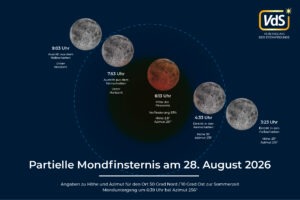
In Zweibrücken, the moon sets at 6:48 a.m. and the sun rises at 6:40 a.m. on August 28.
Wednesday, August 12, 2026; Zweibrücken Observatory, Nationwide Long Night of Astronomy!

The total Solar eclipse On August 12, 2026, the action took place over Greenland, Iceland, Spain, and the Arctic Ocean and the northern Atlantic Ocean . In German-speaking countries, it was visible as a partial solar eclipse. In Zweibrücken, the eclipse magnitude was 89%.
At 7:21 p.m., the Moon began to cover the Sun. The eclipse reached its maximum at 8:15 p.m. The eclipse ended at 8:52 p.m., after the Sun had already set. To celebrate the Long Night of Astronomy and the partial solar eclipse, we opened our observatory from 6:30 p.m. to 11:00 p.m.
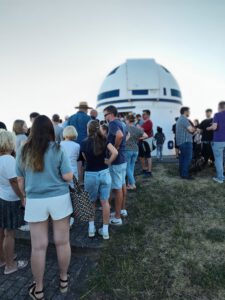
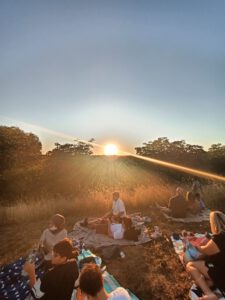
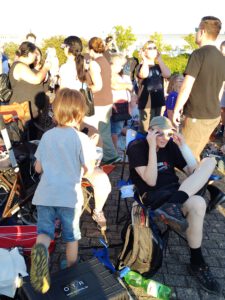
There were 500–600 visitors on the hill at the observatory, including many children, who watched the event. Many watched the eclipse through SOFI glasses on the screen by the observatory door, and there was a long line to view it through the refracting solar telescope in the H-α line with a Fabry-Perot filter and through the C14 reflecting telescope. Many of the visitors stayed afterward to watch the Perseid meteor shower. It was a clear night with good „seeing,“ as astronomers call it.
See also Photo Gallery.
Wednesday, 27.05.2026, 19:00, Audimax and livestream
The Inquisition trial against Galileo Galilei - The difficult relationship between reason and religion
Pierre Leich, President of the Simon Marius Society, Nuremberg
Despite indisputable evidence for the heliocentric view of the world, Galileo Galilei was admonished by the Vatican in 1616 and accused and convicted of heresy in 1633. This is the popular summary of the trial. Galileo is often regarded today as the „Holy Virgin of Orleans of the natural sciences“. But how should his proofs of the Copernican doctrine be assessed from today's perspective? How could an astronomical theory cause such an uproar at the time of the Thirty Years' War and what was really the cause of the conflict with the Church?
Pierre Leich studied philosophy with a focus on the philosophy and history of science. In his lecture, he will talk about a brilliant researcher who changed the way the world was viewed at the time.
Further information :
https://www.art-und-friedrich.de/persons.php?person=10
https://pl-visit.net/index.php?hauptnav=privat&unternav=veroeffentlichungen
https://pl-visit.net/index.php?hauptnav=privat&unternav=aktivitaeten
Wednesday, 29.04.2026, 19:00, Audimax and livestream
Human 2.0 - Do people need an upgrade?
Dr. Verena Lütschg, About Tomorrow Consulting, Baden, Switzerland
Chips in the brain that connect our thoughts to the internet. Gene scissors that eradicate hereditary diseases or create designer babies. Prostheses that can do more than the original, and „inhuman“ senses that open up completely new worlds for us. What was science fiction just a few years ago is already becoming reality in laboratories around the world. Transhumanism promises nothing less than the overcoming of biological limits: a longer, smarter and more efficient life.
But who determines what a „better“ person is? Will enhancement become the privilege of the rich? And if we can optimize everything about ourselves, what is left of being human?
This lecture takes you on a journey to the boundary between man and machine, between medical progress and technological hubris. It shows what is already possible today, what could come tomorrow and why the most important questions are not technical but ethical. Expect no easy answers, but lively discussion, surprising insights and questions that will stay with you.
Verena Lütschg holds a doctorate in molecular biology and has worked in international management consultancies, companies and think tanks. Today, she runs her own technology consultancy „About Tomorrow Consulting“ in Zurich and specializes in knowledge transfer, technological innovations and their social impact.
Further information:
https://www.about-tomorrow.com
⭐ Saturday, 18.04.2026, 10 am - 3 pm, Zweibrücken Observatory
Open Campus Day at Zweibrücken University of Applied Sciences
On the Open Campus Day at Zweibrücken University of Applied Sciences, 18.4.2026, 10 am - 3 pm, members of NAWI e.V. will explain the function and operation of the observatory and telescopes. If the sky is clear, visitors can observe the sun. Keywords: structure of the sun, nuclear fusion, 11-year Swabian periodicity, sunspots, polarity reversal of the magnetic field, heliosphere, effects on our planetary system.
Two lectures will also be offered:
Campus HS Zweibrücken, 11 a.m., Room A 136; 30 min. each.
1 Prof. Dr. W. Arnold: What can be observed with the observatory of the NAWI e.V. on the HS campus?
Based on the observations of the interstellar comet 3I/Atlas and the double quasar Q0957 + 561A/B, the conditions under which this is possible with our amateur observatory are discussed. The observations make it possible to personally experience Kepler's laws and the concepts of escape velocity, curvature of the light path in strong gravitational fields and the use of a quasar as an astronomical microscope.
2 Dr. Rolf-Dieter Schad : The closest star - our sun
Without the sun, eight planets could not have formed and life could not have developed on earth. This seems quite unique, and yet almost all the points of light that can be seen in the night sky are, from a physical point of view, also suns.
How was it created? How is it constructed? Where does it get its energy from? What can be observed with certainty, even with very simple means? What will be its fate in the future?
Wednesday, 08.04.2026, 19:00, Audimax and livestream
The Giotto probe's flyby of Halley's comet
Dr. Gerhard Schwehm, former manager at ESA
A special kind of encounter: 40 years ago, on the night of March 13-14, 1986, Giotto passed Halley's Comet at a distance of just 600 km. It was ESA's first interplanetary mission; a huge success for European science. The probe delivered the first image of a comet nucleus. The Giotto mission provided many new insights into the composition of comets and the interaction of comets with the interplanetary medium.
Why are comets so fascinating? Why have scientists dreamed of a mission to a comet since the beginning of the space age?
Dr. Gerhard Schwehm, former project scientist for the Giotto mission at ESA, will give an overview of the background to the mission and the technological challenges in his lecture. He will show how this mission shaped comet research. He will also share some personal memories with the audience, giving an impression of how fascinating it is to be involved in such a project.
Further information:
https://de.wikipedia.org/wiki/Halleyscher_Komet
Livestream:
Of course, we are looking forward to welcoming as many guests as possible, but we will offer those who do not have the opportunity to come to Zweibrücken the opportunity to follow our lectures live via the Internet. The livestream will be online from approx. 18:45 on the day of the lecture and can also be accessed from outside the university (without registration or access data).
The link is the same for all presentations and reads:
Astronomy Day on March 28, 2026
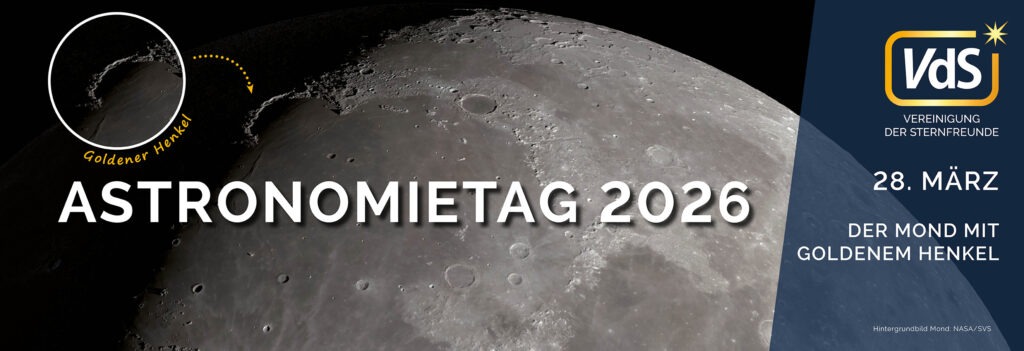
On the nationwide Astronomy Day 2026, observatories, planetariums, research institutes, museums, schools and individuals (organizers throughout Germany, Austria and Switzerland) are once again inviting people to explore the world of stars with their own eyes. The program includes the gas giant Jupiter with its four large moons, our sister planet Venus and a large moon formation, the so-called Golden Handle.
The Naturwissenschaftliche Verein zu Zweibrücken NAWI e.V. opens its observatory from 19:00 to 23:00. If the sky is cloudy, we will explain our observatory and the instruments we use.
Admission is free, advance registration is not necessary.
Wednesday, 14.01.2026, 19:00, Audimax and livestream
Dr. Christoph Endres, sequire technology GmbH, Saarbrücken
AI between protective shield and offensive weapon
Artificial intelligence (AI) is changing our world, it is both a tool and a weapon: AI can protect us from cyber attacks or be misused by attackers.
AI systems consist not only of software, but also of data and complex models that offer new areas of attack - for example through manipulated training data or targeted deception. They can analyze huge amounts of data, detect suspicious patterns at an early stage and thus help to ward off attacks before damage is done. However, AI can also be used by cyber criminals, for example to generate deceptively real phishing emails or for automated hacks.
The presentation will show how AI systems can be secured, how they contribute to defense and why they also pose new risks.
Dr. Christoph Endres is a computer scientist with over 20 years of professional experience in AI research. He is Managing Director of sequire technology GmbH, a small Saarbrücken-based company that focuses on the security of AI systems. He also teaches AI in a university environment at the Scheer School for Digital Sciences, heads an expert group for AI security in cooperation with the German Federal Office for Information Security (BSI) and is a cybersecurity expert at the German Federal Network Agency.
Further information:
Of course, we are looking forward to welcoming as many guests as possible, but we will offer those who do not have the opportunity to come to Zweibrücken the opportunity to follow our lectures live via the Internet. The livestream will be online from approx. 18:45 on the day of the lecture and can also be accessed from outside the university (without registration or access data). The link is the same for all lectures:
Astronomy Day
Since the International Year of Astronomy in 2009, NAWI has been participating regularly in the activities of the Astronomy Day
Open Campus
On the university's annual "OpenCampus" day, we open the observatory if the weather is suitable. We explain how the technology and telescopes work and can offer the following observations:
- Observations of the sun with its spots, granules, and prominences with our H-alpha telescope and other telescopes.
- Observations of planets and even stars during daytime if conditions permit.