Wednesday, 04.12.2024, 19:00, Audimax and livestream
Dr. Ulrich Eberl, futurologist, biophysicist, author
Hydrogen in all colors - new sources for the most important substance of the energy transition
In future, Europe will need tens of millions of tons of hydrogen every year: for the conversion of the steel and chemical industries, for heavy trucks and aircraft and for electricity in dark doldrums. But where will these enormous quantities come from? Perhaps from natural gas, with the resulting carbon dioxide being stored? That would be so-called "blue" hydrogen. Or as "green" hydrogen from the electrolysis of water with wind or solar power? This could be produced in windy Chile or in the deserts of Africa and Australia.
Little known until now: There are also areas around Europe where ten times more hydrogen could be produced than the continent needs. This refers to the open ocean more than 100 kilometers off the coasts of Norway, Scotland, Ireland down to Portugal and Spain. There, floating wind turbines could produce green hydrogen, which would then be bound to organic oils and transported safely and cheaply to land by tankers. The first pilot project is already underway.
Perhaps even more surprising: in northern France near Saarland, researchers believe they have found something that shouldn't even exist: large natural hydrogen reservoirs underground. If these millions of tons of "white" hydrogen actually exist, this would also be an important contribution to a climate-neutral future for Europe.
Ulrich Eberl, who holds a doctorate in biophysics, worked in industry for 23 years and has been a freelance science journalist and author since 2015. His focus is on trends up to 2050: environment and energy, health and mobility, industry and artificial intelligence.
Further information about Dr. Ulrich Eberl:
https://www.linkedin.com/in/ulrich-eberl-0aab0a1/ and www.zukunft2050.wordpress.com
Article on floating wind farms and white hydrogen (Bild der Wissenschaft, March 2024):
https://www.wissenschaft.de/magazin/bdw-aktuelles-heft/was-waere-wenn-3/
Livestream:
We would of course be delighted to welcome as many guests as possible, but would like to offer those who do not have the opportunity to come to Zweibrücken the opportunity to follow the lecture live (and only live!) via the Internet. A recording of the lecture is not planned.
The livestream will be online from approx. 18:45 on the day of the lecture and can also be accessed from outside the university (without registration or access data). The link is the same for all lectures and reads:
Wednesday, 20.11.2024, 19:00, Audimax and livestream
Dr. Marc Okrand, inventor of the Klingon language, Washington D.C.
Klingon - how a fictional language turned real
This lecture will be in English. English abstract below.
Dr. Marc Okrand, the inventor of the Klingon language, will report on how it came about to develop a "real" language for the television series Star Trek and what has become of this language. The lecture will be in English. Abstract in English below!
Klingon, a language developed for the 1984 film Star Trek III: In Search of Mr. Spock, was intended to be unlike any other language on Earth, but still recognizable as a real language and not just a meaningless "babble". To be both alien and natural, the language was constructed to follow various linguistic principles and violate them at the same time.
Once the basic grammar and vocabulary were established, the language underwent unexpected changes during filming, as actors occasionally mispronounced words and writers revised dialog or changed the translations in subtitles. As the number of Star Trek productions increased, especially on television, Klingon was heard more and more frequently, with various writers and producers introducing new words or phrases.
At the same time, a community of "Klingon speakers" developed and the language was used in more and more general contexts. Klingon in the 23rd century was no longer limited to conversations appropriate for alien warriors in space, but evolved into a language suitable for translating literary works, composing one's own songs and stories, or simply talking about everyday problems on Earth in the 21st century.
English Version:
Klingon, a language created for the film Star Trek III: The Search for Spock in 1984, was designed to be unlike any language on Earth but still be recognizable as an actual language and not just random noise. To be both alien and natural, the language was constructed by following and yet also violating various linguistic principles.
Once the basic grammar and vocabulary were established, the language underwent unanticipated alterations because of the process of filmmaking itself as actors occasionally mispronounced words and writers revised dialogue or changed the translations in subtitles. As the number of Star Trek productions increased, especially on television, Klingon was heard more and more frequently, with new words or phrases introduced by various writers and producers.
At the same time, a community of Klingon speakers developed and the language started being used in ever more general contexts. No longer restricted to conversations appropriate for alien warriors in outer space in the 23rd century, Klingon was becoming a language appropriate for translating works of literature, composing original songs and stories, or just talking about everyday concerns on 21st-century Earth.
Further information:
https://de.wikipedia.org/wiki/Marc_Okrand
https://memory-alpha.fandom.com/de/wiki/Marc_Okrand
Livestream:
We would of course be delighted to welcome as many guests as possible, but would like to offer those who do not have the opportunity to come to Zweibrücken the opportunity to follow the lecture live (and only live!) via the Internet. A recording of the lecture is not planned.
The livestream will be online from approx. 18:45 on the day of the lecture and can also be accessed from outside the university (without registration or access data). The link is the same for all lectures and reads:
Wednesday, 06.11.2024, 19:00, Audimax and livestream
Prof. Dr. Markus Groß (Linguist at the HS KL) and Lieven L. Litaer (The Klingon Teacher)
How to invent a language - Esperanto, Klingon and co.
The linguist Markus Groß will first give an insight into interlinguistics, a field of linguistics that deals with so-called "planned languages". He will then present some projects of artificially created languages. Volapük was the first language created for the purpose of international communication that had a following. It was replaced by Esperanto, which is probably at least understood by several million people today and in which there are translations of a large part of world literature. In his lecture, Groß will also discuss "literary" artificial languages, such as those found in J.R.R. Tolkien's "The Lord of the Rings".
Prof. Markus Groß studied phonetics and phonology, Romance studies, Indo-European studies, Oriental studies and applied linguistics. Before he was appointed to the university in Zweibrücken in 1994, he worked as an interpreter and translator and as a lecturer for German at Kasetsart University in Bangkok.
Klingon expert Lieven L. Litaer provides an insight into the origins of the Klingon language. What was the purpose of the language and for whom was it designed? Who is the inventor of the language and how did he manage to invent thousands of words?
The Klingon teacher, as he calls himself, translated the subtitles into Klingon for the series "Star Trek: Discovery". He works closely with the inventor of the Klingon language, who considers him to be one of the best Klingon speakers on the planet. In addition to textbooks and dictionaries on Klingon, Litaer has also translated literary classics such as "The Little Prince" and "Alice in Wonderland" into Klingon. In "real life" Lieven Litaer works as an architect in Saarbrücken.
Further information:
https://de.wikipedia.org/wiki/Markus_Gro%C3%9F_(Linguist)
https://lieven-litaer.de
https://de.wikipedia.org/wiki/Lieven_L._Litaer
https://klingonisch.de
https://www.amazon.de/s?k=klingonisch
Livestream:
We would of course be delighted to welcome as many guests as possible, but would like to offer those who do not have the opportunity to come to Zweibrücken the opportunity to follow the lecture live (and only live!) via the Internet. A recording of the lecture is not planned.
The livestream will be online from approx. 18:45 on the day of the lecture and can also be accessed from outside the university (without registration or access data). The link is the same for all lectures and reads:
Wednesday, 23.10.2024, 19:00, Audimax and livestream
Prof. Dr. Walter Arnold, Professor of Materials Engineering at the UdS and 1st Chairman of NAWI
The Rosetta comet mission - a review after 10 years
Comets are remnants of the formation of the solar system and consist of ice, dust and loose rock. They formed in the outer, cold regions of the solar system. Even in early times, comets aroused great interest because they appeared suddenly and behaved completely differently from other celestial bodies. They were therefore often regarded as messengers of fate or signs of the gods.
In August 2014, the ESA space probe Rosetta reached the comet 67P/Churyumov-Gerasimenko after a flight lasting more than 10 years. The aim of the Rosetta mission was to determine the physical and chemical properties of the comet. The "orbiter" Rosetta had the "lander" Philae on board, which landed on the comet on 12.11.2014. The mission came to an end on September 30, 2016, when the orbiter also touched down on the comet and then lost communication with Rosetta.
Ten different measuring instruments were operated on both Rosetta and Philae, including the SESAME ("Surface Electric Sounding and Acoustic Monitoring Experiment") experiment with the CASSE (Comet Acoustic Seismic Sounding Experiment) instrument, which was co-developed at Fraunhofer IZFP in the GR department. These measurements are based on non-destructive testing methods, the field of work of Fraunhofer IZFP, in which Prof. Arnold was active during the Rosetta mission.
An overview of the course of Rosetta's flight and the course of the mission is given and the most important results from CASSE and other Rosetta instruments are presented, especially on the composition of the cometary material and the question of whether the water was brought to Earth by comet impacts.
Prof. Arnold held various positions as a scientist in solid state physics and applied physics - both in academia and in industry. From 1980 until his "retirement" at the end of 2007, he worked at the Fraunhofer Institute for Non-Destructive Testing in Saarbrücken. In 1989, he was appointed Professor of Materials Engineering at Saarland University. Since 2009, he has been a visiting professor at the Institute of Physics at the University of Göttingen and also works as a freelance consultant.
Further information:
https://de.wikipedia.org/wiki/Rosetta_(Raumsonde)
Livestream:
We would of course be delighted to welcome as many guests as possible, but would like to offer those who do not have the opportunity to come to Zweibrücken the opportunity to follow the lecture live (and only live!) via the Internet. A recording of the lecture is not planned.
The livestream will be online from approx. 18:45 on the day of the lecture and can also be accessed from outside the university (without registration or access data). The link is the same for all lectures and reads:
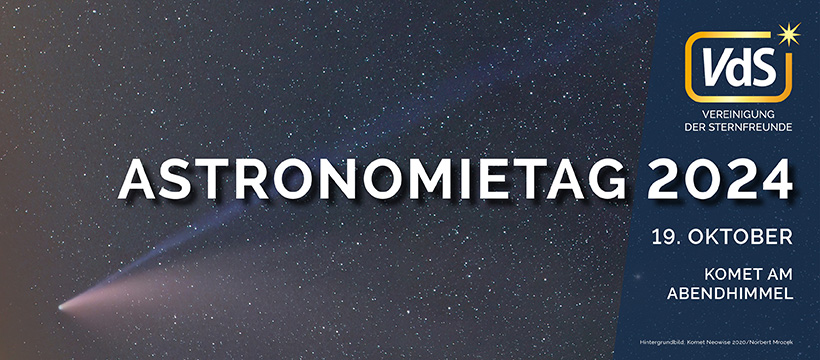
Astronomy Day and comet on October 19, 2024!
See the universe with your own eyes
On October 19, 2024, observatories, planetariums, etc. will be inviting visitors. (Organizers throughout Germany and Switzerland) once again invites you to explore the world of stars with your own eyes - for the best visibility of the ringed planet Saturn, with the moon near the Pleiades and the comet C/2023 A3 (Tsuchinshan-ATLAS) in the evening sky.
Comet in the evening sky
An easily observable, conspicuously bright comet is at the top of the wish list of amateurs and astronomy enthusiasts worldwide. It is not yet clear whether comet C/2023 A3 (Tsuchinshan-ATLAS), which was discovered at the beginning of 2023, will fulfill the hopes placed in it - it is certainly a good candidate and on Astronomy Day it will be easily observable in the sky in German-speaking countries. But even if the brightness of Tsuchinshan-ATLAS should develop unfavorably, Astronomy Day still has a lot to offer!
The starry sky on Astronomy Day
In mid-October, you can say goodbye to the summer constellations in the evening: In the southwest, the constellations Swan, Lyra and Eagle are still high in the sky. Their three main stars, Deneb, Vega and Atair, form the so-called "summer triangle". When the sky is dark, the band of the Milky Way can be seen here, but the waning moon above the eastern horizon is already brightening the sky. A closer look later reveals the striking Pleiades star cluster directly above the moon. In a south-easterly direction, the ringed planet Saturn shines in an otherwise star-poor environment in Aquarius.
During the course of the night, the summer constellations set in the west, the autumn constellations pass to the south, the winter constellations appear in the east and with them Jupiter in the constellation Taurus, which is accompanied by moons that can be clearly seen through the telescope of an observatory. If you hold out until after midnight, you can even greet the sky hunter Orion.
The NAWI Association opens on 18.10. and on Astronomy Day, 19.10., already at 7 p.m. the observatory for comet observation. Furthermore, on 16.10.2024 at 7 pm in the colloquium of the HS Zweibrücken the lecture "Simon Marius - The physician, astronomer and mathematician died 400 years ago" will take place. Another lecture will take place on 23.10.2024 at 19:00, also in the colloquium: "The Rosetta comet mission - a review after 10 years" on the occasion of the landing of the Philae lander on comet 67P 10 years ago.
Details of the presentations directly after this text or directly above it.
Wednesday, 16.10.2024, 19:00, Audimax and livestream
Dr. Rolf-Dieter Schad, ophthalmologist from Zweibrücken and NAWI member
Simon Marius - The physician, astronomer and mathematician died 400 years ago
Only those interested in the history of astronomy know that Simon Marius (1573 -1624) discovered the four large moons of Jupiter at the same time as Galileo Galilei.
The International Astronomical Union proclaimed 2009 the "International Year of Astronomy", which focused on Johannes Kepler and Galileo Galilei. Kepler published the book "Astronomia Nova" 400 years earlier and Galileo published his discovery of Jupiter's moons. At the time, this was a threshold between antiquity and modern times in which the world view began to change fundamentally.
However, it was not only Kepler and Galileo who used the newly invented telescope, but also others who tended to go unnoticed by the general public. One of these was the Franconian doctor, astronomer and mathematician Simon Mayr, known as Marius. He discovered the four large moons of Jupiter at the same time as Galileo, but at the time was subject to bullying and accusations of plagiarism, which continued into the 20th century. Reason enough to report on the life and discoveries of Simon Mayr.
Dr. Rolf-Dieter Schad is well known in Zweibrücken as an ophthalmologist. He has been an active member of the Natural Science Association of Zweibrücken (NAWI) for almost 20 years and has contributed a great deal to the modernization of the observatory. His numerous observations of the sky and the Simon Marius Society's call to commemorate the 400th anniversary of the southern German astronomer's death inspired him to give this lecture.
Further information:
https://de.wikipedia.org/wiki/Simon_Marius
Link to a commemorative publication for the anniversary year of Simon Marius:
https://www.simon-marius.net/pix/content/26/Marius-Jubilaeum-2024_Praesentation.pdf
Livestream:
We would of course be delighted to welcome as many guests as possible, but would like to offer those who do not have the opportunity to come to Zweibrücken the opportunity to follow the lecture live (and only live!) via the Internet. A recording of the lecture is not planned.
The livestream will be online from approx. 18:45 on the day of the lecture and can also be accessed from outside the university (without registration or access data). The link is the same for all lectures and reads:
The night of the shooting stars - observing the Perseids in August 2024
It's that time again. This year's maximum of the Perseids will take place on the evening of August 12. These can already be observed on the nights before and after. It is not uncommon to see so-called fireballs or bolides with a brightness comparable to the brightest stars. This year's rate of up to 25 shooting stars per hour will be somewhat lower than in previous years.
Provided the night sky is clear, we will open our observatory on Friday, August 9, Saturday, August 10 and Sunday, August 11 from 9 p.m.. After it has become sufficiently dark, you can observe the shooting stars yourself on the grounds next to the observatory. Also under AllSky7.net you can watch the recordings of the AllSky network of meteors, as shooting stars are also called, throughout Europe. Our association operates a camera in this network (see camera under AMS59 (Zweibrücken/DE) on the map shown).
After dark, we also offer a look through our telescopes at the objects in the summer night sky under expert guidance and explanation.
Wednesday, 05.06.2024, 19:00 Audimax
Jasmin Gratz
The Nebra Sky Disk - Astronomy of the Bronze Age
The Nebra Sky Disk is regarded as the archaeological find of the century. It is the oldest known realistic depiction of the (night) sky and has fundamentally revolutionized our view of Central European Bronze Age culture. It was found in an area that archaeologists had previously assumed was inhabited by primitive peoples in the Bronze Age, which was attributed in particular to the lack of writing. The discovery of the Sky Disc by grave robbers led to an extensive archaeometric study of the bronze disc.
The Sky Disc initially presented archaeologists with many puzzles about its origin, age and significance. The production of the Sky Disc is divided into five phases, which, among other things, suggests its use as a calendar and sheds new light on Bronze Age astronomy.
Today, the Sky Disc is housed in the Landesmuseum Halle and is the centerpiece of the exhibition.
Jasmin Gratz completed her studies in May 2023 with the first state examination at Saarland University as a teacher of mathematics and physics. Since then, she has been completing her traineeship as a teacher for secondary level I and secondary level II in both subjects in Saarland. In her final thesis, Ms. Gratz dealt with the Nebra Sky Disk and its applications for physics lessons.
Livesteam:
We are of course looking forward to welcoming as many guests as possible, but would like to offer those who do not have the opportunity to come to Zweibrücken next Wednesday the opportunity to follow the lecture live (and only live!) via the Internet. There will be no recording of the lecture via this channel. The livestream will be online on Wednesday from around 18:45 and can also be accessed from outside the university.
The direct link to the livestream:
Wednesday, 24.04.2024, 19:00 Audimax and livestream
Dr. Gerhard Schwehm
Planetary Protection
Planetary Protection (PP) is the protection of bodies in the solar system from contamination by terrestrial life and, conversely, the protection of Earth from possible life forms brought back to Earth by other bodies.
All space agencies observe the rules and requirements laid down by COSPAR, the Committee on Space Research. These rules are based on the current state of scientific knowledge we have about the objects in our planetary system and are proposed by a panel of experts from COSPAR, the Planetary Protection Panel.
Planetary protection has been discussed since the beginning of space travel; as early as 1958, the International Council of Scientific Unions (ICSU) set up a committee "on Contamination by Extraterrestrial Exploration (CETEX)" to address the concerns of many scientists that space missions to the moon and other bodies in the solar system could compromise their future scientific exploration. This task was assigned to COSPAR shortly afterwards. COSPAR created the International Standard for Planetary Protection, which since 1967 has also been regarded as a guideline for compliance with the requirements of Article IX of the UN Outer Space Treaty.
Starting with the Apollo missions to the moon and the Viking missions to Mars, we will show how the PP requirements have developed. Using the example of the ESA Juice Mission to the moons of Jupiter, we will see what needs to be taken into account when building a spacecraft in order to meet the requirements. The major future challenges for PP will be the return of soil samples from Mars to Earth and the first astronauts on Mars.
PP is always in close contact with the mission planners to ensure that international agreements are adhered to. The actual purpose is to support scientific research into chemical evolution and the origin of life in the solar system.
Livestream:
We are of course looking forward to welcoming as many guests as possible, but would like to offer those who do not have the opportunity to come to Zweibrücken next Wednesday the opportunity to follow the lecture live (and only live!) via the Internet. There will be no recording of the lecture via this channel. The livestream will be online on Wednesday from around 18:45 and can also be accessed from outside the university.
The direct link to the livestream:
Participation of the observatory in Open Campus 2024
The Zweibrücken Observatory will be taking part in the Zweibrücken Campus Open Day on 20.04.2024.
We open our observatory from 10:00 to 14:00 and offer our visitors an insight into the world of astronomy. We not only explain how our telescopes work, but also the technology behind them. In addition, our guests have the opportunity to observe the sun in a safe and expert manner.
Wednesday, 10.04.2024, 19:00, Audimax
The lecture by Prof. Dr. Hans-Ulrich Keller on neutron stars has to be postponed. Instead, the following lecture will take place on this day:
Mathias Jäger (Scientific / Technical Director, Planetarium Mannheim)
34 years of the Hubble Space Telescope - a success story
April 25, 2024 marks the 34th anniversary of the launch of the NASA/ESA Hubble Space Telescope. Dr. Mathias Jäger, former ESA press officer for the telescope, takes a look at the incredible success story of Hubble, the scientific breakthroughs it has made possible, but also the setbacks and problems of the mission. He also asks the question: What can a 34-year-old scientific instrument still achieve today? And to what extent has Hubble become obsolete due to the new James Webb Space Telescope?
Wednesday, 27.03.2024, 19:00, Audimax
Dr. Helmut Warth, HYTRAC Team, Mannheim
The German space transporter project SÄNGER: "A technology of tomorrow that came to the museum yesterday!"
This lecture was originally planned for 17.01.2024 and had to be postponed due to the weather conditions.
SÄNGER is a concept for a reusable space transporter that was designed by the German space pioneer Prof. Dr.-Ing. Eugen Sänger. It was first developed in the 1960s for a two-stage launcher system. In the mid-1980s, this idea was taken up again by the then German aerospace company Messerschmitt-Bölkow-Blohm and, with the support of the Ministry of Research and Technology, the SÄNGER II project was launched, which no longer received political support from 1995 onwards due to the reorganization of the aerospace industry in Europe. However, test components and technical know-how were saved for the museum, where they now lie dormant in an aircraft hangar.
The HYTRAC team (Hypersonic Transportation Consulting), which consists of a group of former SÄNGER II project employees and close friends around Prof. Dr.-Ing. Dr. h. c. Peter A. Kramer, the late former development manager of the SÄNGER II propulsion technology, and his youngest son, Rolf Kramer, have made it their mission to bring this hypersonic project back to life. After almost 40 years, this technology is still innovative, more environmentally friendly, more sustainable and more relevant than ever for civil and defensive applications in the aerospace industry.
Dr.-Ing Helmut Warth, who has more than 35 years of professional experience in the fields of aerospace, fluid mechanics and automotive engineering, is the HYTRAC team member responsible for the technical coordination and public funding of this project. Together with his colleagues, he will report on the history and current status of the project.
Livestream:
We are of course looking forward to welcoming as many guests as possible, but would like to offer those who do not have the opportunity to come to Zweibrücken next Wednesday the opportunity to follow the lecture live (and only live!) via the Internet. There will be no recording of the lecture via this channel. The livestream will be online on Wednesday from around 18:45 and can also be accessed from outside the university.
The direct link to the livestream:
https://video.hs-kl.de/Panopto/Pages/Sessions/List.aspx?folderID=8bd1420d-8297-4209-976d-af8200a6d151
Further information is available at:
https://de.wikipedia.org/wiki/Sänger_(space transportation system)
Wednesday, 31.01.2024, 19:00, Audimax
Dr. Rolf-Dieter Schad (ophthalmologist in ZW and NAWI member)
The Milky Way and beyond into the depths of space
On dark nights, you can see a shining band in the sky next to many stars. This is the Milky Way, our home galaxy. In order to keep an overview, the stars were grouped into constellations in ancient times. Size and surface temperature vary greatly, from brown dwarfs to blue supergiants.
Many stars are in double or multiple systems, in open star clusters or very numerous and close together in globular clusters. Star-forming regions, dying stars and supernovae and their remnants can also be observed. Approximately 2.4 million light years away, the Andromeda galaxy can even be seen with the naked eye as a small patch of light. Countless galaxies follow in the depths of space. Some of the easily observable objects are summarized in the famous Messier catalog. The entire universe is expanding, and even amateur astronomers can detect the resulting red shift.
Dr. Rolf-Dieter Schad is known to the people of Zweibrücken as an ophthalmologist. He has been an active member of the Natural Science Association of Zweibrücken (NAWI) for almost 20 years and has contributed a great deal to the modernization of the observatory. His numerous observations of the sky and the motto of the Science Year 2023 "Our Universe" inspired him to give this lecture.