Wednesday, 03.12.2025, 19:00, Audimax and livestream
Dr. Hubert Zitt, University of Applied Sciences in Zweibrücken
The light and dark side of artificial intelligence
Artificial intelligence (AI) has made a lot of headlines recently. With ChatGPT, Sora and Deepfakes, AI has reached a stage where even some scientists are critical of it. The hype surrounding artificial intelligence should not hide the fact that there have been several incidents in the past where AI systems have taken paths that even the programmers could not foresee. In order to achieve the programmed goal, one AI system was proven to have lied; another spoke of being afraid of being shut down. And we humans can no longer be sure whether the images or videos we see on social media are real or fake. The current world situation also raises the issue of „AI in weapons systems“, which understandably makes many people uneasy.
In his presentation, Hubert Zitt will compare the advantages and disadvantages of artificial intelligence and critically question where it can benefit us and where we should be careful in the future. Comparisons with scenes from science fiction films will of course not be missing from Zitt's presentation.
Further information:
wikipedia.org/wiki/Hubert_Zitt
Of course, we are looking forward to welcoming as many guests as possible, but we will offer those who do not have the opportunity to come to Zweibrücken the opportunity to follow our lectures live via the Internet. The livestream will be online from approx. 18:45 on the day of the lecture and can also be accessed from outside the university (without registration or access data). The link is the same for all lectures:
Wednesday, 12.11.2025, 19:00, Audimax and livestream
Cantabile Niederauerbach with the mixed choirs Eintracht Falkenbusch and Hengstbach
„TIME WARP“ - a crazy journey through music history
Who said you can't travel through time? Three choirs from the region prove the opposite - at least musically!
With their concert program „Time Warp“, they invite you on a shrill, surprising and absolutely unforgettable journey through time. From the 19th century to the swing of the 60s to the current hits of recent years. Look forward to an evening full of musical highlights from different decades, peppered with fashionable trends and explosive information that is guaranteed to lead to a few flashbacks!
But beware: this journey through time doesn't quite go according to plan! The specially developed time machine suddenly malfunctions - and the choirs find themselves in the middle of an unpredictable tour through space and time. Nobody knows which decade they will be sent to next - and a detour into the future is not out of the question!
Further information:
http://www.cantabile-zweibruecken.de
Of course, we are looking forward to welcoming as many guests as possible, but we will offer those who do not have the opportunity to come to Zweibrücken the opportunity to follow our lectures live via the Internet. The livestream will be online from approx. 18:45 on the day of the lecture and can also be accessed from outside the university (without registration or access data). The link is the same for all lectures:
Monday, 13.10.2025, 19:00, Audimax and livestream
Prof. Dr. Katharina Zweig, Department of Computer Science at the RPTU in Kaiserslautern
Does the AI know that it knows nothing?
Soon, we should be able to have all tedious tasks done by intelligent chatbots such as ChatGPT and Co. in the form of AI agent systems. But how exactly do the language models work? Do they have intellectual abilities that are similar to or even exceed those of us humans? The lecture will show what ChatGPT and co. can really do and what they cannot, because language models can neither summarize, compare, analyze nor evaluate in the human sense, even if it often looks like it. The speaker shows how important it is not to confuse human and machine performance and warns impressively against spectacular, perhaps even fatal failures when using AI agent systems based on language models. She also discusses the use of ChatGPT in teaching.
Katharina Zweig is a computer science professor at RPTU in Kaiserslautern, where she founded the Socioinformatics degree program, the only one of its kind in Germany. She works as an expert for various federal ministries, among others, has received several prestigious awards and was appointed AI ambassador for the state of Rhineland-Palatinate in 2020. Her latest book "Weiß die KI, dass sie nichts weiß?" will be published at the end of September and was voted one of the ten most important business books in 2025 by Handelsblatt.
After the lecture, the bookstore Thalia will be selling books by Prof. Zweig, which the author will also be happy to sign.
Further information:
wikipedia.org/wiki/Katharina_Zweig
aalab.cs.uni-kl.de/gruppe/zweig/
www.youtube.com/watch?v=PBIuEbuEmZ8
Of course, we are looking forward to welcoming as many guests as possible, but we will offer those who do not have the opportunity to come to Zweibrücken the opportunity to follow our lectures live via the Internet. The livestream will be online from approx. 18:45 on the day of the lecture and can also be accessed from outside the university (without registration or access data). The link is the same for all lectures: hs-kl.de/livestream
Total lunar eclipse on Sunday 07.09.2025
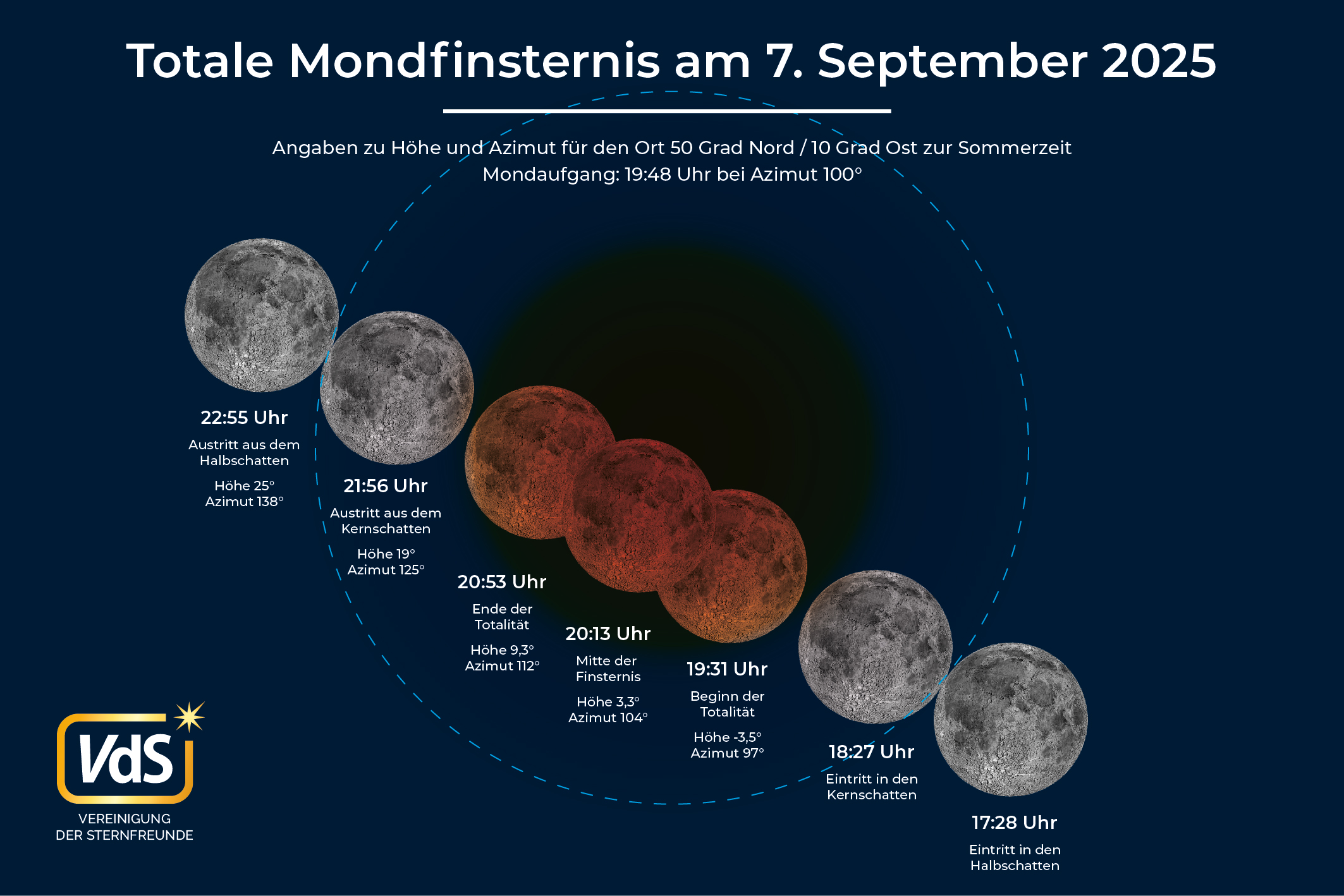
On 07.09.2025, the second half of a total lunar eclipse can be observed in Zweibrücken. To mark this event, the observatory will open at 19:30 on this day, weather permitting.
The sun sets at 20:04 on this day. The total eclipse begins at 19:31. The already totally eclipsed moon rises in Zweibrücken at 19:55. The total eclipse ends at 20:53, the partial eclipse at 21:56.
A lunar eclipse can only take place at full moon when the sun, earth and moon are aligned. However, as the moon's orbit is inclined about 5 degrees to the orbital plane of the sun (ecliptic), the moon usually passes above or below the area where there is an exact alignment for an eclipse, so that this event does not take place at every full moon.
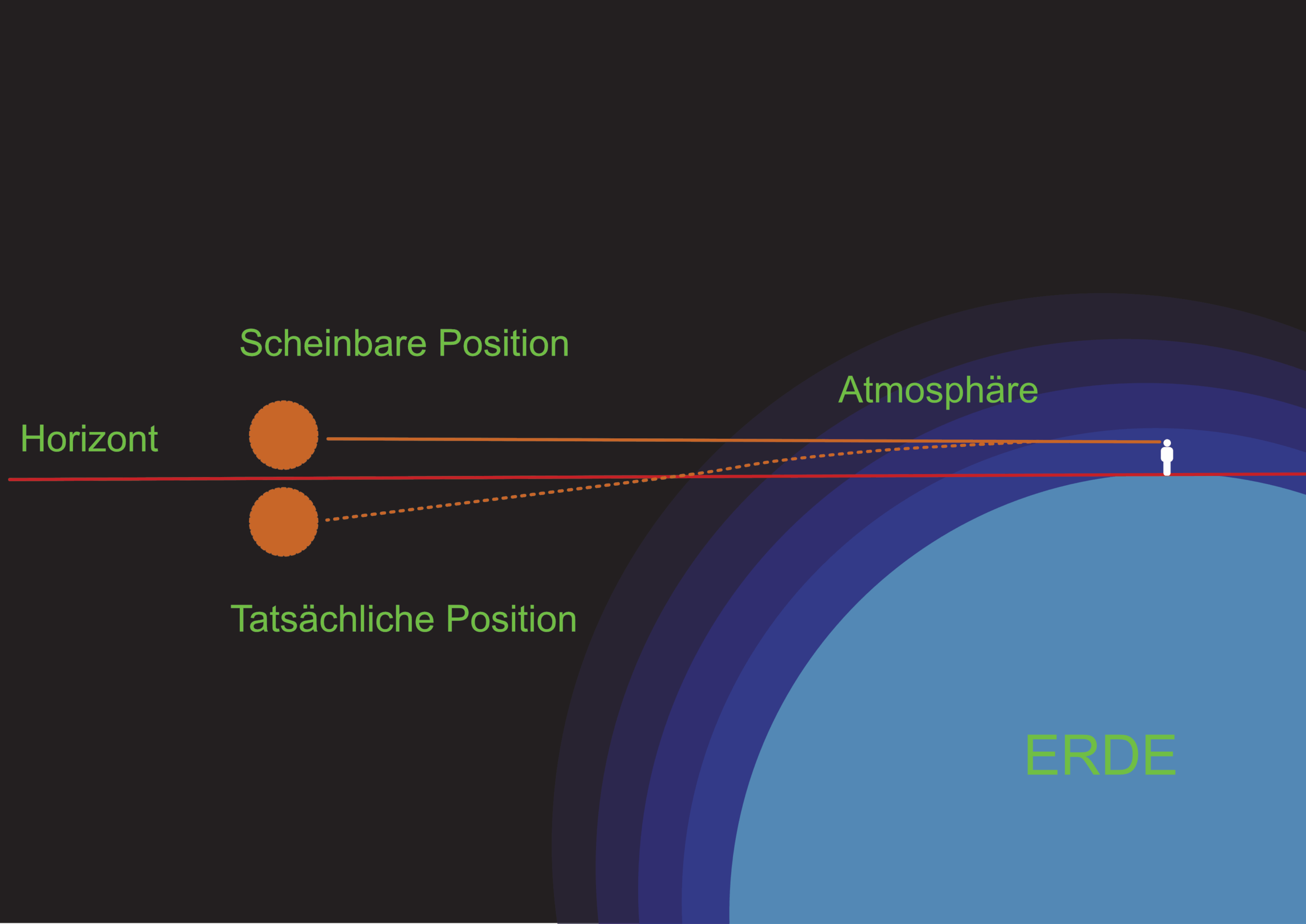
Sunset and moonrise do not coincide exactly during a total lunar eclipse. Actually, one would think that sunset and moonrise should coincide during a total lunar eclipse because, as mentioned above, the three celestial bodies sun, earth and moon are in a line. However, the light is refracted in the Earth's atmosphere due to differences in density. As a result, celestial bodies appear slightly higher than they are geometrically. This is also known as refraction. We therefore still see the sun above the horizon, although geometrically it has already set. Similarly, we see the moon already risen, although it is geometrically still below the horizon. The rays of light from both celestial bodies are refracted by the atmosphere towards the earth so that they can be seen simultaneously just above the horizon.
The night of the shooting stars on 12.08.2025
We open on 12.8. from 9 pm the observatory for observations when the sky is clear. At the same time, visitors can observe the falling of shooting stars outside the dome and count them, i.e. determine the number of falls per hour in astronomical terms. Join in the count!
Every year from August 10 to 14, the Earth crosses the orbit of the comet "Swift-Tuttle" and flies through its dust trail. If such a comet dust particle enters the Earth's atmosphere, it burns up and flits across the sky as a shooting star. This is why a particularly large number of shooting stars can be seen every year in mid-August. This is known as the "Perseids" or the "Laurentius Tears". The maximum of the Perseids is expected on the night of August 12-13. A few days after the full moon, the Earth's companion brightens the sky considerably and therefore only the brightest shooting stars, also known as bolides, will be visible.
Wednesday, 21.05.2025, 19:00, Audimax and livestream
Martin Bertges, Dr. Bertges Vermessungstechnik, Neunkirchen am Potzberg
The "Potsdam potato" - the problem of measuring heights
When we talk about height measurement in everyday life, we mean the measurement of a small-scale height difference. Simple school geometry is no longer sufficient to determine the heights of buildings or mountains whose peaks can only be reached from the ground or valley with great effort, because the earth is not a disk. This is already clearly measurable at a distance of 200 meters.
Thanks to satellite navigation, it is now possible to determine your position anywhere on earth to within a few meters using a smartphone, but the altitude is rather imprecise because satellite navigation is a mathematical process in which the earth is assumed to be an ellipsoid. High-precision altitude determination is carried out with the help of a physical phenomenon in which the geoid plays a role. However, this does not have a uniform shape, which brings us to the potato.
Height measurement has its pitfalls and the small insight into geodesy is also an insight into the broad spectrum of geosciences. Height measurement is also a good example of interdisciplinary work in the engineering sciences of mathematics, optics, geophysics and astronomy.
Martin Bertges is co-founder and co-owner of the company "Dr. Bertges Vermessungstechnik" and is professionally involved with systems and services for satellite navigation, deformation monitoring and remote sensing.
Additional information for e-mail announcements:
https://www.solarify.eu/2012/10/18/potsdamer-kartoffel/
Livestream:
We would of course be delighted to welcome as many guests as possible, but would like to offer those who do not have the opportunity to come to Zweibrücken the opportunity to follow the lecture live (and only live!) via the Internet. A recording of the lecture is not planned.
The livestream will be online from approx. 18:45 on the day of the lecture and can also be accessed from outside the university (without registration or access data). The link is the same for all lectures and reads:
Wednesday, 07.05.2025, 19:00, Audimax and livestream
Dr. Dr. Gert Mittring, world champion in mental arithmetic, gifted diagnostics in Bonn
Calculating with the world champion - spectacular mental arithmetic strategies explained in an understandable way
Arithmetic without too much memory stress. Using examples, mental arithmetic world champion Gert Mittring will present strategies on how seemingly difficult tasks can be solved surprisingly easily in your head. Tasks such as determining the day of the week for a date or an increasing root can be solved methodically with almost no mental arithmetic.
In addition, Hubert Zitt will set the world champion math problems about Star Trek, which he will solve live on stage without any technical aids. What is the stardate on a certain date? How long does the starship Enterprise need at warp 5 to reach the Klingon homeworld? In the second part of the lecture, the two doctors will combine fun with science and show that Mr. Spock's estimates are better than anyone else's calculations.
Dr. Dr. Gert Mittring is eleven-time world champion in mental arithmetic, two-time Olympic champion in mental arithmetic and has been the reigning German mental arithmetic champion since 08.12.2024. He calculates faster in his head than a "normal" person can type the numbers into a calculator. Mittring studied computer science and then completed a doctorate in educational science and psychology. He has been a frequent guest on television programs, has written several books and works as a freelance scientist in the field of giftedness diagnostics. In his lecture, he will demonstrate his skills to guests and give helpful math tips for studying and everyday life.
Additional information for e-mail announcements:
https://de.wikipedia.org/wiki/Gert_Mittring
https://www.gertmittring.de
https://diagnostik-mittring.de/
Livestream:
We would of course be delighted to welcome as many guests as possible, but would like to offer those who do not have the opportunity to come to Zweibrücken the opportunity to follow the lecture live (and only live!) via the Internet. A recording of the lecture is not planned.
The livestream will be online from approx. 18:45 on the day of the lecture and can also be accessed from outside the university (without registration or access data). The link is the same for all lectures and reads:
Wednesday, 23.04.2025, 19:00, Audimax and livestream
Udo Schmidt, entrepreneur from Blieskastel and state guild master in the electrical trade
Energy independence in your own home - optimal use of photovoltaics
Photovoltaic systems (PV systems) are currently on everyone's lips. Especially if you own your own home, it is worth thinking about installing a PV system. On the one hand, you are making a contribution to climate protection and it can also be economically attractive.
What do homeowners have to expect when installing a PV system? How does the installation work and when does this investment pay off? The location, number, orientation and inclination of the PV modules are decisive factors. How can you use your "own electricity"? With power-to-heat technology, surplus solar power can be efficiently converted into heat. Heat pumps, heating elements or buffer storage tanks ensure that renewable energy is used to heat water and support the heating system. This reduces gas or oil consumption and increases the self-consumption rate.
Dynamic electricity tariffs offer the opportunity to purchase or feed in electricity when prices are particularly low or high. The correct dimensioning of a battery storage system is crucial for economic efficiency and self-sufficiency.
With your own PV system, an electric car can of course also be charged in a cost-effective and climate-friendly way. Intelligent wallboxes control the charging process so that as much solar power as possible flows directly into the car. This reduces energy costs and the vehicle becomes part of the household energy management system.
An outlook on future technologies in connection with PV systems rounds off the evening lecture.
The speaker Udo Schmidt is a master craftsman in electrical engineering, an expert in photovoltaics, has been a board member of the Saarland State Guild of Electrical Trades since 2013 and has been the state guild master of the electrical and information technology trades in Saarland since 2022. In 1996, he founded the company Elektro Udo Schmidt GmbH in Blieskastel and has since installed over 4000 PV systems.
Additional information for e-mail announcements:
https://www.elektro-udo-schmidt.de/
https://www.facebook.com/elektroudoschmidt/?locale=de_DE
The Zweibrücken Observatory will take part in the open day of the Zweibrücken campus on Saturday, April 5, 2025.
We open our observatory from 10:00 to 14:00 and offer our visitors an insight into the world of astronomy. We not only explain how our telescopes work, but also the technology behind them.
When the sky is clear, our guests have the opportunity to observe the sun safely and expertly.
If the weather does not permit solar observation, our member Dr. Schad invites you to a lecture entitled "Blick ins Weltall" at 1:00 pm in room A123. He will cover general topics about the universe, with a focus on amateur astronomy.
Astronomy Day and partial solar eclipse on March 29, 2025
Just six months after the nationwide Astronomy Day 2024, the Astronomy Day 2025 will follow, and for good reason - a partial solar eclipse will take place at midday on Saturday.
For this reason, the Zweibrücken Observatory, together with many other astronomical associations, will be open from 10 am to 2 pm. Under cloudy skies, we will explain our observatory and the instruments we use in detail.
In addition, we are offering a lecture regardless of the weather: "The sun and its observation". The lecture will take place at 11:00 a.m. in the chapel (first traffic circle on the right hand side of the campus coming from the city center).
If the sky is clear, you have the opportunity to observe the partial solar eclipse through our telescopes under expert guidance and explanation.
Never look into the sun yourself under any circumstances without suitable protective measures. There is a risk of serious eye damage!
In Zweibrücken, the partial phase begins at 11:18 and ends at 12:59. The peak of the eclipse will be reached at 12:08 pm with an eclipse of approximately 18%.
See also: The starry sky in March
Admission is free, advance registration is not necessary.
Wednesday, 15.01.2025, 19:00, Audimax and livestream
Prof. Dr. Moritz Weber, Saarland University
The software of quantum computing
Many hopes are associated with quantum computers: they should be able to calculate faster, better and more comprehensively. And above all - different. At the same time, there is an eerie feeling: quantum computers must have something to do with incredibly complicated quantum physics - so mere mortals will never be able to understand them, let alone operate them.
However, if you separate quantum computing into the hardware on the one hand and the software on the other, as with classical computing, then it becomes clear that while the development of the hardware, i.e. the construction of a quantum computer, does indeed require some knowledge of quantum physics, this is not necessary for the software and operation of the quantum computer - just as hardly any software developer understands the electromechanics in their own laptop, but can still program it.
We take a closer look at a few buzzwords on the software side: What are qubits? What is entanglement? How can you make use of it and how do you program a quantum computer? What are the basic principles and examples of quantum algorithms and why is it already an advantage for classical computers to know them? Neither knowledge of physics nor programming skills are required for this lecture.
Professor Moritz Weber researches the unknowns in the "equation" of the quantum cosmos at Saarland University. His field is quantum mathematics. With his models, he tries to contribute to making quantum physics more predictable and easier to understand.
Further information:
https://www.saarland.de/DE/presse-informationen/medienservice/pressearchiv/stk/stk-medieninfo-archive/2021/Q1_2021/pm_2021-02-26-neuer-professor-moritz-weber
https://idw-online.de/de/news783204
Livestream:
We would of course be delighted to welcome as many guests as possible, but would like to offer those who do not have the opportunity to come to Zweibrücken the opportunity to follow the lecture live (and only live!) via the Internet. A recording of the lecture is not planned.
The livestream will be online from approx. 18:45 on the day of the lecture and can also be accessed from outside the university (without registration or access data). The link is the same for all lectures and reads: