The Starry Sky in September 2026
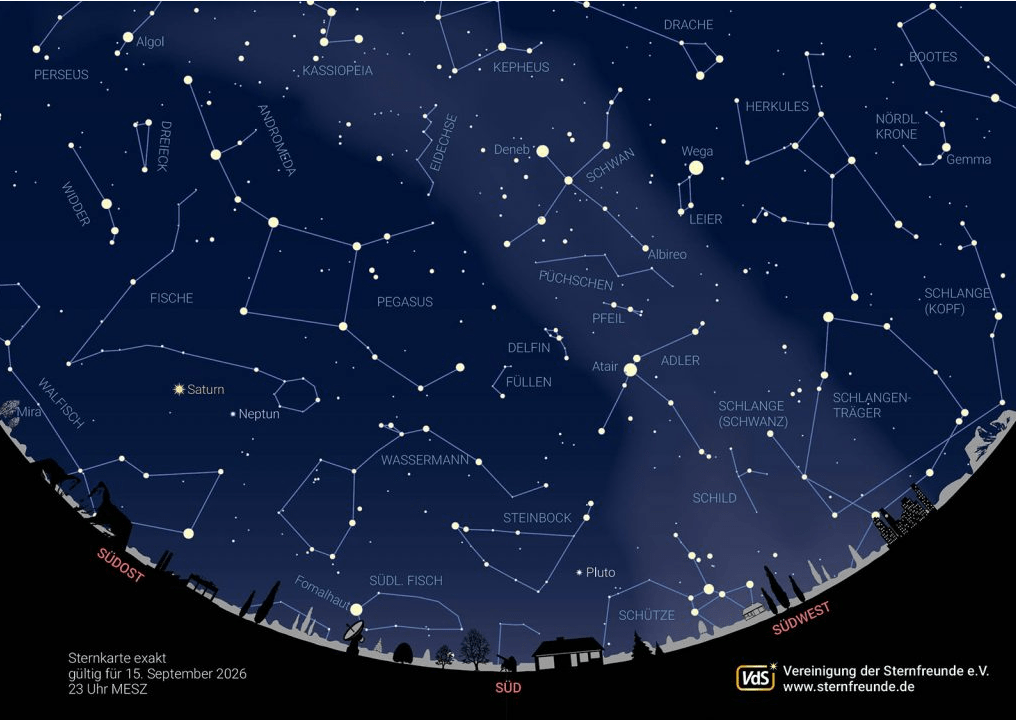
After the bright summer nights, it gets dark much earlier again in September. Most of the constellations can already be seen at around 21:30. First to fall vertically above us is the bright star Away up. If you look there again later, when it has become completely dark, you will also see the small diamond-shaped constellation Lyre in which Vega is the brightest star. If you do not see Lyra, you may not have seen Vega, but perhaps the star Atair (constellation Eagle) or Deneb (constellation Swan) in view. Vega, Altair, and Deneb together form a large triangle known as the „Summer Triangle.“ In the middle of the Summer Triangle and slightly to the left of it, you’ll find the constellations Arrow and Dolphin. Neither of them has any bright stars, but since they're so small, their shapes aren't immediately noticeable. Now the Milky Way visible as a pale, shimmering band high above our heads. Both the western part of the sky, with the early summer constellations setting, and the eastern sky, with the autumn constellations rising, are sparse in bright stars. In the constellation Pisces, a star shines Saturn, A little way west of there, you can Neptune observe.
The Moon Phases in September 2026

The Planets in September 2026
Mercury It is moving farther away from the Sun and, by the end of September, will be 23 degrees east of it. However, since it is located farther south than the Sun, it cannot be observed in Europe at dusk.
Venus Its visibility in the evening is now rapidly diminishing, and it will fade away in the bright evening twilight by the end of September. On September 14, the waxing moon will cover Venus in the late morning hours. In the evening, the moon will be visible next to Venus.
Mars It travels through the constellation of Gemini and appears alongside the stars of that constellation in the morning sky. By the end of September, the red planet will be in the constellation of Cancer.
Jupiter Mars rises in the morning. The giant planet is first visible in the constellation Cancer and then in the constellation Leo. On September 9, the narrow crescent of the waning moon can be seen below Jupiter.
Saturn is once again moving along its retrograde path from the constellation of Pisces into that of Cetus. It will reach opposition in early October and will therefore move significantly up the observation list in September.
Uranus begins its opposition cycle in the constellation of Taurus in September. In September, the greenish planet is still visible only in the second half of the night.
Neptune In the constellation Pisces, it will reach its opposition for this year as early as the end of September and will then be visible all night long.
Adapted from The Starry Sky in September 2026 – Association of Star Enthusiasts e.V.