The starry sky in January 2026
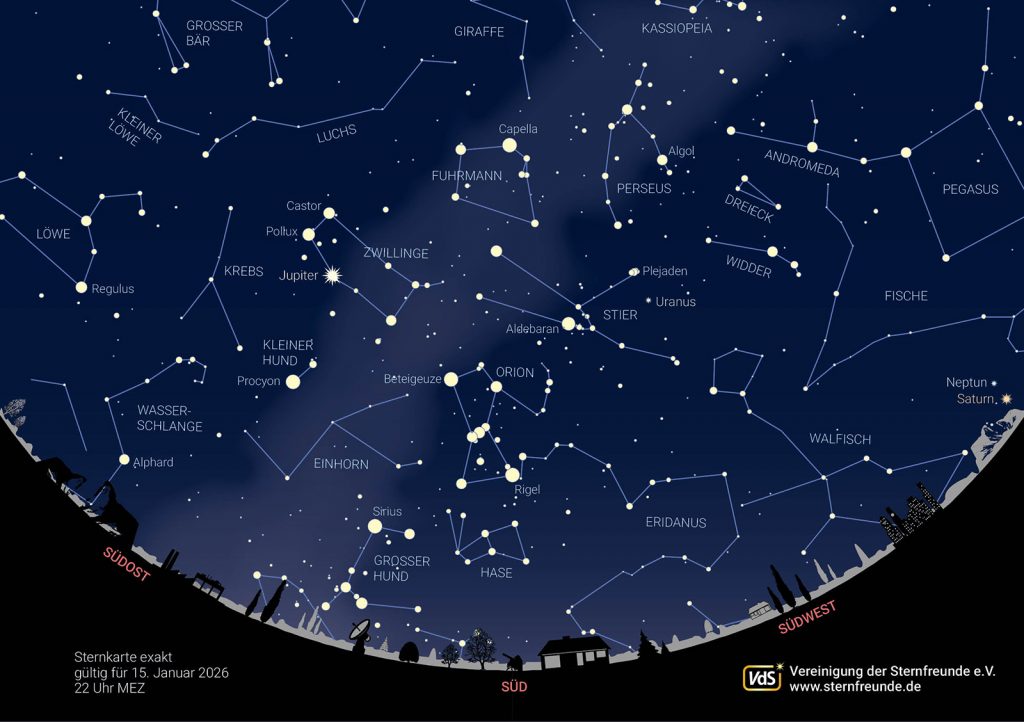
On the January star chart - it is valid for 15.1., 10 p.m. - you can recognize the best-known winter constellation, the Orion. Its seven stars are all very bright. You can easily imagine the human body of the sky hunter in the shape they form. Below the three „belt stars“, the pale, shimmering Orion Nebula can be seen with binoculars. The lower right star of Orion, Rigel, is also the lower right corner of the Winter hexagons. The winter hexagon is not a constellation, but a large figure made up of six bright stars from different constellations. Clockwise, Rigel in Orion is followed first by Sirius (in the constellation Big dog), then Prokyon (in the Small dog), Castor (in the Twins), Kapella (in the Carter), and finally Aldebaran in the Bull.
The Winter Milky Way passes through the constellations of the Great Dog, Unicorn, Gemini, Taurus, Carthus, Perseus and Cassiopeia. It is not as bright as in summer, as we are currently looking towards the edge of our galaxy from Earth.
The planets in January 2026
Mercury was only visible in the morning at the beginning of December 2025. In January 2026, the closest planet to the sun will also not be visible in the night sky.
Venus reaches its upper conjunction with the Sun on January 6 and is only visible in the daytime sky in January.
Mars is in conjunction with the Sun on January 9 - the red planet is therefore not visible.
Jupiter comes into opposition on January 10 in the constellation Gemini. The giant planet therefore offers optimal observation conditions.
Saturn moves from the constellation of Aquarius into the constellation of Pisces and is an object in the evening sky. Its distance from Neptune decreases over the course of the month. On January 23, Saturn is close to the waxing moon.
Uranus in the constellation Taurus is in the weeks following opposition and can therefore still be seen south of the Pleiades for most of the night.
Neptune in the constellation of Pisces is located not far from Saturn and, like the ringed planet, is an object for the evening hours.
The moon phases in January 2026

In modified form from: The starry sky in January 2026 - Vereinigung der Sternfreunde e.V.