The Starry Sky in November 2026
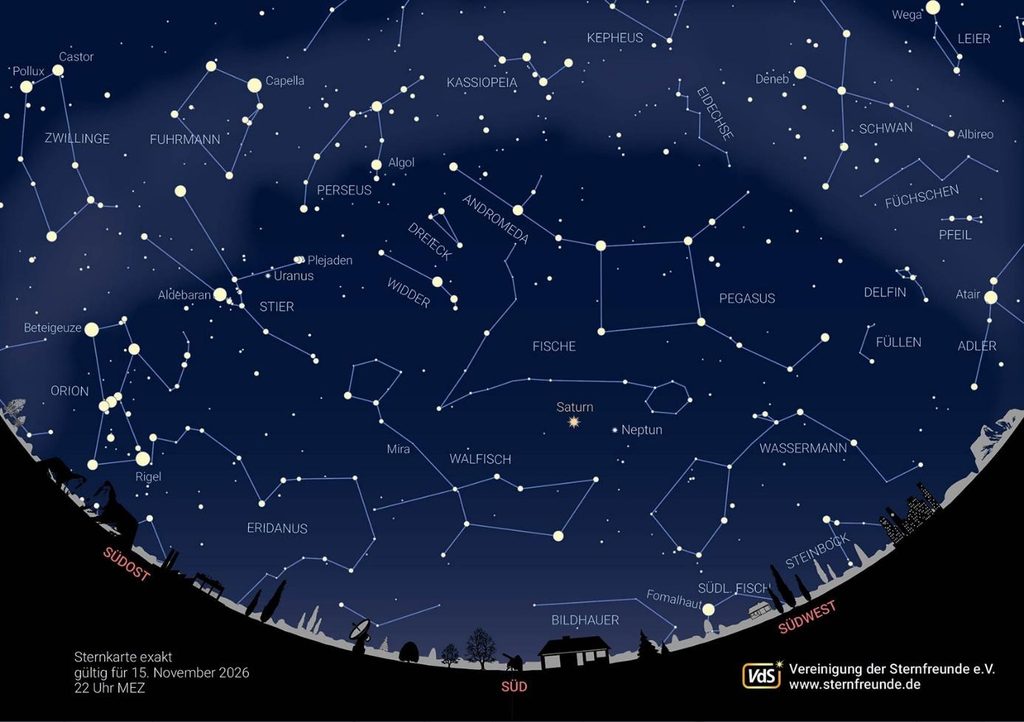
The typical constellations of the fall night sky are the huge constellation Pegasus, with the upper-left corner already belonging to the Andromeda is called; the Pegasus Square is also known as Autumn Quadrangle. Below Pegasus and Andromeda, only constellations with faint stars are visible: In the southwest of the Aquarius, in the south of the Whale and above that, the Fish.
In the east, the constellations of the winter sky are already appearing, with much brighter stars: Directly overhead is the Cassiopeia (the „Heavenly W“), followed by the southeastern horizon, Perseus (including the variable star Algol) and the Bull featuring the striking Pleiades star cluster and the reddish star Aldebaran. The Sky Hunter has just risen Orion with its seven very bright stars.
Saturn and Neptune At 10 p.m., they cross the meridian in the border region between the constellations Cetus and Pisces. High in the southeast, Uranus in Taurus invites observation.
The Moon Phases in November 2026

The Planets in November 2026
Mercury It appears in the eastern morning sky from mid- to late November. It reaches its greatest western elongation on November 13, at an angular distance of just under 20 degrees from the Sun; it is most visible around November 21.
Venus appears in the morning sky after its inferior conjunction in late October. It
It is located not far from Spica in the constellation Virgo and can point the way to Mercury, which lies lower in the sky. On November 7, the trio of Venus, Spica, and the waning crescent moon will be visible.
The Mars Mars passes through the constellation Leo and now rises after midnight. By the end of November, Mars will be near Regulus. As early as mid-November, Mars will have a close encounter with Jupiter.
The Jupiter It is also located in the constellation Leo and, like Mars, rises after midnight—until November 15, when it rises after Mars, and thereafter before the red planet. On November 3, the waning Moon is below Jupiter and Mars, and on November 30, it is above the planets.
Saturn is in the month following its opposition—it therefore rises earlier in the evening and sets earlier in the morning.
The Uranus In the constellation of Taurus, it reaches its opposition to the Sun at the end of November—the opposition occurs. Its position between the constellations of the Hyades and the Pleiades offers opportunities for beautiful star field photographs.
The Neptune In the constellation Pisces, its period of opposition is slowly coming to an end. The distant planet is becoming a feature in the evening sky.
Adapted from The Starry Sky in November 2026 – Association of Star Enthusiasts, Inc.