The Starry Sky in August 2026
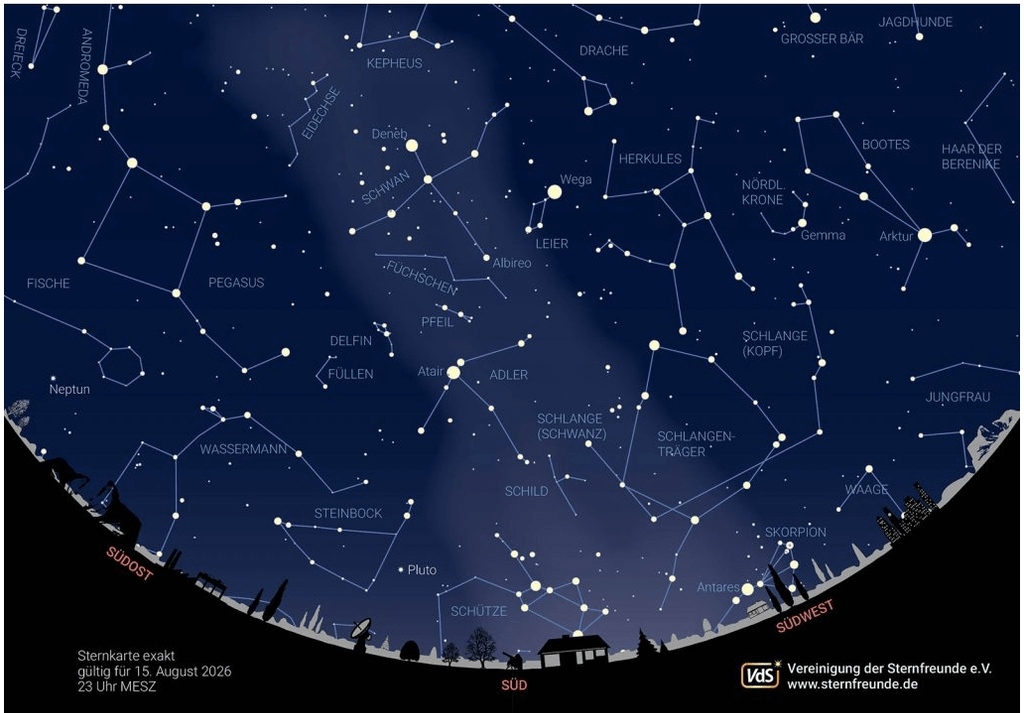
In August, you can take your time admiring the summer night sky when the first stars begin to appear after 10 p.m. If you look straight up around 11 p.m., you’ll see the bright star Vega in the constellation Lyre can be seen. Together with Vega, two other bright stars form the "summer triangle": to the left of Vega is the star Deneb in the constellation Swan and a good distance towards the horizon the star Atair in the constellation Eagle. As soon as it gets really dark again at night starting in mid-August, you can make out the band of the Milky Way stretching right through the Summer Triangle. In the east, with Pegaus and Andromeda the first signs of fall. Deep in the southeast, Neptune rises above the horizon in the constellation Pisces.
The Night of the Shooting Stars
Every year, from August 10 to 14, Earth crosses the orbit of the comet „Swift-Tuttle“ and passes through its dust trail. When a grain of cometary dust enters Earth’s atmosphere, it burns up and streaks across the sky as a shooting star. That is why a particularly large number of shooting stars can be seen in mid-August each year. These are known as the „Perseids“ or the „Tears of St. Lawrence.“ The Perseids are expected to peak on the nights of August 12–13 and August 13–14. Shortly after the new moon, viewing conditions will be optimal this year.
A solar eclipse will take place on August 12: A total eclipse over Iceland, Spain, and the Balearic Islands, and a partial eclipse over the rest of Europe. And on the morning of the August 28 followed by a partial (almost total) lunar eclipse. Up-to-date information will be available in due course at www.sternfreunde.de.
The Moon Phases in August 2026

The Planets in August 2026
Mercury It will be visible only in the morning until mid-August—very early in the morning due to the time of year. On August 2, Mercury reaches its greatest western elongation. On August 11, the narrow crescent Moon will be above Mercury, and on August 15, Mercury will pass by Jupiter.
Venus It will reach its greatest eastern elongation on August 15, so it will still be visible in the evening sky, but it will set earlier and earlier. On August 16, the waxing moon will pass the evening star.
Mars is an object in the morning sky and is moving from the constellation Taurus into that of Gemini. On August 9, the waning moon is near the position of Mars.
Jupiter will be visible again in the morning sky at the end of August. In early August, Jupiter will pass the open star cluster Messier 44 to the south in the constellation Cancer. As early as July 15, Jupiter will be overtaken by the faster Mercury. It’s a challenge to observe this at dawn.
Saturn It rises in the constellation Pisces in the early evening and is worth observing later in the evening.
Uranus In Taurus, it becomes visible earlier in the morning; by the end of August, it is already rising in the late evening.
Neptune Like Saturn, it is located in the constellation Pisces and will reach its opposition for this year at the end of September.
In modified form from The Starry Sky in August 2026 – Association of Star Enthusiasts e.V.