The starry sky in May 2026
Due to the increasing length of the day, the useful observation times will be reduced from five hours at the beginning of May to just two hours at the end of the month. This would mean that the start of observations of galaxies and similar faint objects would be postponed from 23:00 CEST to 0:30 CEST. For this reason, the observatory will only be open from May 2 to the end of August during certain times. These include, for example, the observation of the sun and the moon on some weekends. The times will be announced via a ticker on our main page and our public WhatsApp channel announced.
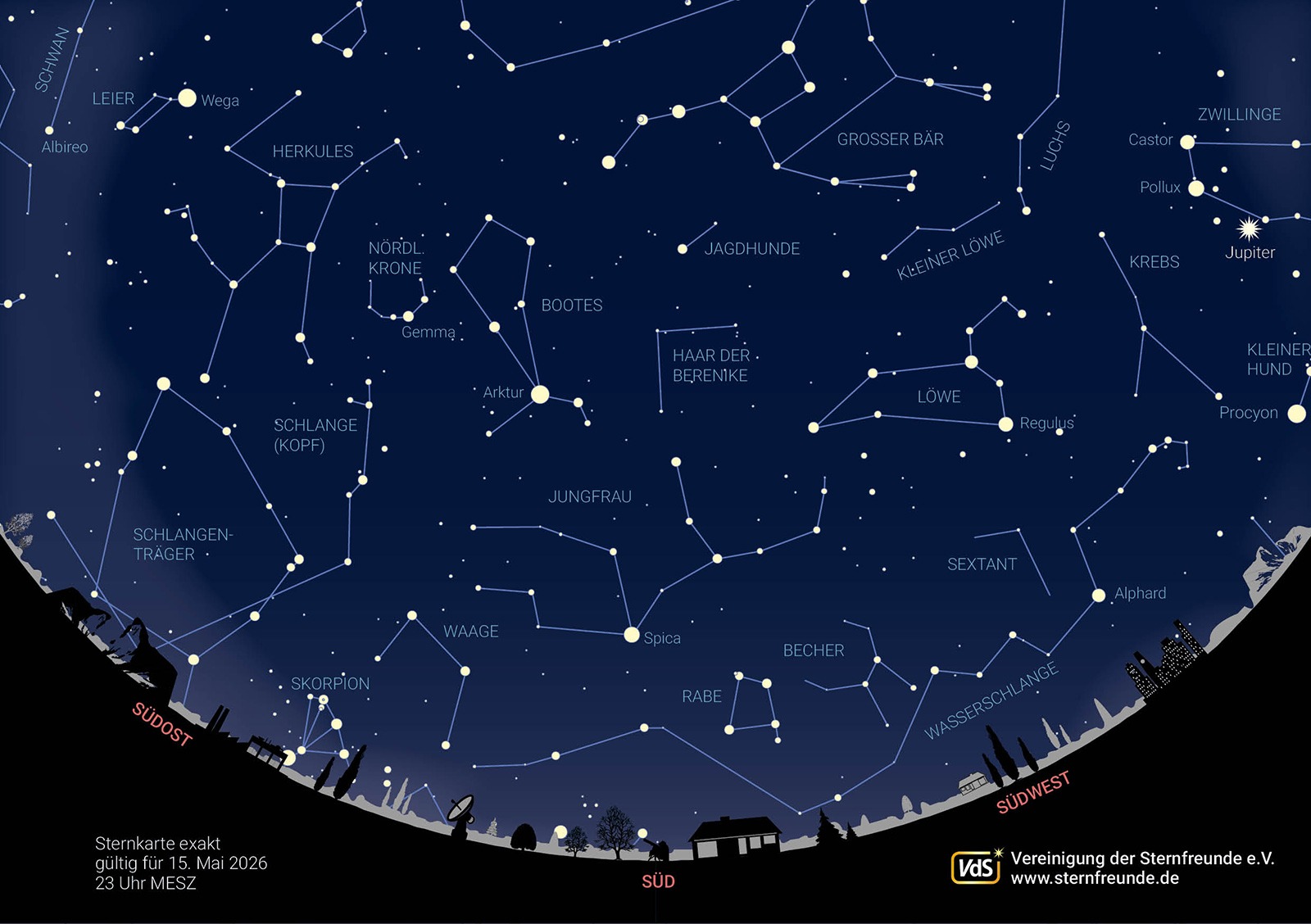
As soon as it gets dark in the evening, you will find the constellation Virgo above the southern horizon. Its brightest star is called Spica. A little further up in the sky shines Arcturus, the brightest star in the constellation Boats, the herdsman. Regulus falls in the southwestern direction in the constellation of the Lions up. The three stars Spica, Arcturus and Regulus together form the so-called Spring Triangle. Slightly above the spring triangle is the pale constellation Hair of Berenice. Towards the south-eastern horizon, the transition from the spring to the summer starry sky announces itself. Just above the south-eastern horizon, the constellation of the Scorpions on.
If you observe the evening sky in May, you will still be able to make out some bright stars of the winter constellations in the west, but they will soon set. It is still Jupiter in the constellation of the Twins to see.
In contrast, the summer constellations are already appearing in the eastern sky: Far to the east, Vega, the main star of the constellation, stands out Lyre. On the connecting line between the bright stars Vega and Arcturus is the faint constellation Hercules and the semicircle of the Northern Crown to see.
The moon phases in May 2026

The planets in May 2026
Mercury is eclipsed by the sun on May 14 and can be seen above the late evening western horizon at the end of May.
Venus first passes through the constellation of Taurus and, from May 19, that of Gemini. On May 18, it is close to the narrow, waxing crescent moon. It now increasingly lives up to its name „evening star“.
Mars moves more than 30 degrees away from the sun by the end of May, but is not yet visible in the morning sky.
Jupiter moves clockwise through the constellation of Gemini. It sets shortly before midnight during the month.
Saturn in the whale can be seen again in the eastern morning sky at the end of May.
Uranus in the constellation Taurus will be very close to the Sun in the daytime sky on May 22.
Neptune in the constellation of Pisces is not yet visible due to the bright dawn.
In modified form from The starry sky in May 2026 - Vereinigung der Sternfreunde e.V.